
Cut the Clutter: Zinsser's Proven Framework for Writing That Resonates
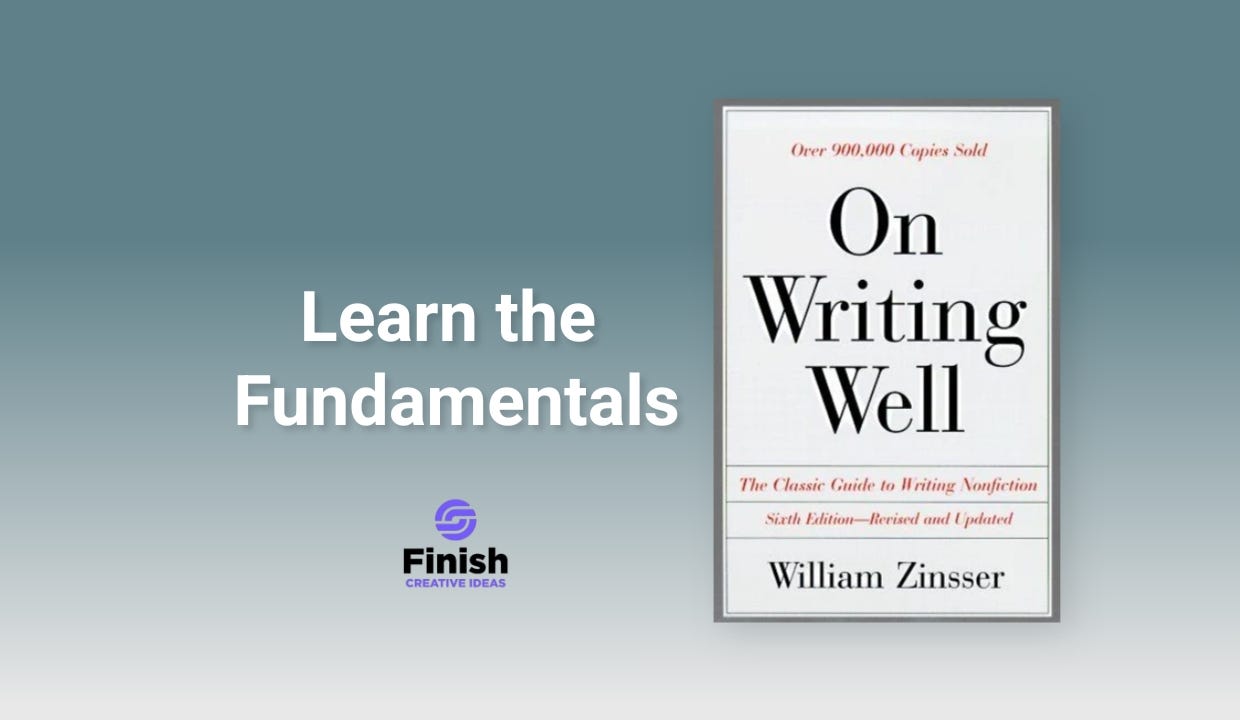
Inspiration From "On Writing Well," William Zinsser's Classic Nonfiction Guide

Hey Creatives!
It’s time to go back to 1976. Yes, this is a Boomer moment.
I was graduating high school and trying to get my writing groove going.
I don’t remember how I stumbled upon William Zinsser’s book, “On Writing Well,” but it set the tone for a lifetime of improving the craft of writing.
That was just under 50 years ago.
My memory may not serve me well. I may have not read the book when it first came out. It might have been two or three years later while in college.
Nonetheless, “On Writing Well” is one of the first self-help books I read that really did help.
And, in truth, the anecdotal stories told by Zinsser are quite mundane. You can skip the setups.
It’s a craft book. It’s for anyone who still believes good writing matters.
In the advent of AI-assisted writing, it offers an antidote. It’s invaluable to train your own writing muscle to understand the weaknesses of AI-generated content.
What a pivotal moment to utilize the power of AI, while pursuing the craftwork and developing your own style.
This is a separation point to distinguish your uniqueness.
If I can pinpoint one skill, after five decades, that’s allowed me to pursue and fulfill my dreams, it is writing. This is your ticket to punch too.
Zinsser's central premise is deceptively simple: writing is thinking on paper.
There is one overarching goal to achieve: clarity.
Let’s dive into some of the details.
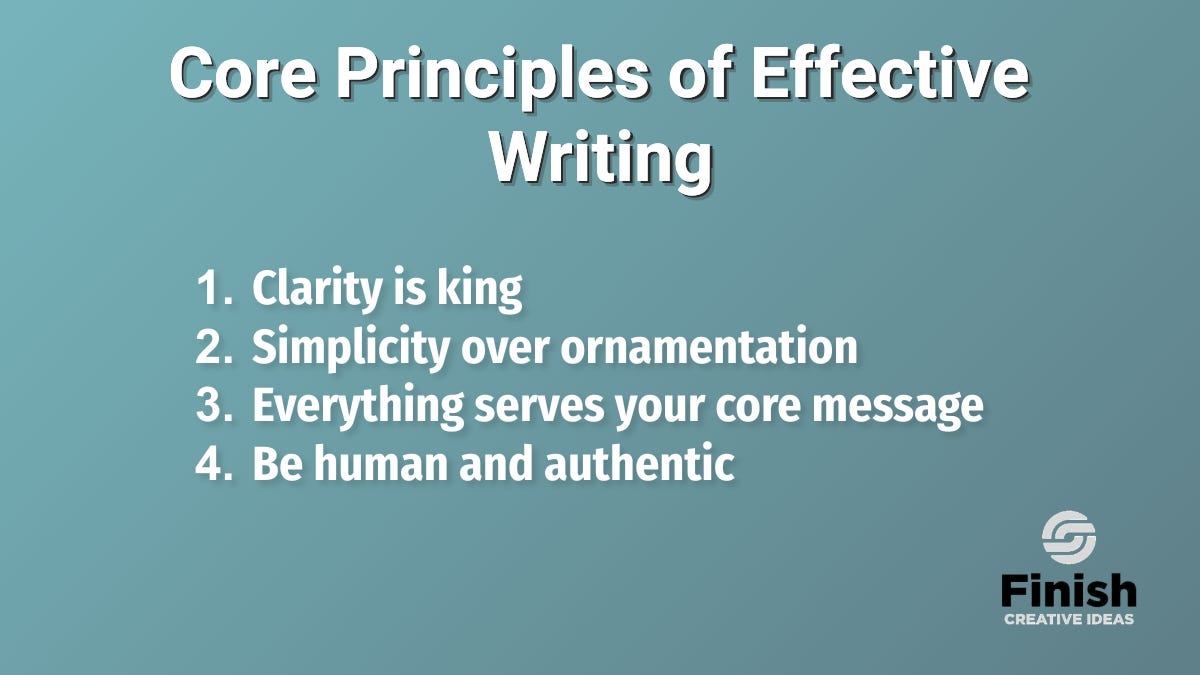
The Core Principles of Effective Writing
What is good writing all about?
It’s not about grandiose language or complex structures; it's about simplicity, clarity, and authenticity.
That’s the essence. That’s why Zinsser’s book is a classic. It sticks to the fundamentals.
Zinsser argues that by stripping away unnecessary words and focusing on the essence of your message, you can communicate more effectively with your audience.
His philosophy is brutal but liberating: good work isn't about adding more – it's about cutting everything that doesn't matter.
It’s an important concept to absorb for any creative project.
Let’s start with some key takeaways from “On Writing Well:”
Focus on Clarity: Ensure readers understand what you're trying to say without confusion.
Simplicity Matters: Cut clutter and complexity from your writing; every word should serve a purpose.
Rewrite Relentlessly: Good writing often requires multiple drafts.
Authenticity is Key: Let your personality shine through in your work.
By applying these insights, creatives can refine their craft and produce content that engages readers while staying true to their unique voice.
1. Clarity Is King
Writing is hard work. A clear sentence is no accident. Very few sentences come out right the first time, or even the third time.
For Zinsser, clear thinking produces clear writing—and the reverse is also true. When you're stuck on a project, it's often because you're not clear on what you're really trying to say.
Try this test: If you can't explain your project's purpose in one simple sentence, you need to clarify your thinking first.
Progress is difficult without knowing which road you’re traveling on. Writing is a struggle until you smooth out the bumps to gain momentum.
Sometimes, the hardest decision about any article is how to begin it.
And writing requires extra effort at the front end to set the path ahead. Revisions and stripping out complexity comes later.
So clear your mind, determine your purpose and start with conviction.
Then carry that clarity forward with every sentence and paragraph.
2. Simplicity Over Ornamentation
Strip every sentence to its cleanest components.
Simplicity and removing clutter overlap in their intent, though they differ in some aspects.
Simplicity implies being succinct. It means keeping on track and sticking to the program. It’s a minimalist approach that eliminates using too many bells and whistles to illustrate a point.
It is not sterile in its presentation, but it does not over-accessorize by wearing gaudy jewels and exhibiting flashy behavior.
Of course, clutter is a nuisance too.
Too many words get in the way or hide the true message in a bloated word salad.
Writing in simple sentences allows you to refrain from wandering into unknown territory, where you don’t know the landscape well and you lose the audience.
If clarity is king, then simplicity acts as a servant to hone the message.
3. Remove Everything That Doesn't Serve Your Core Message
The most important words are the ones you decide to exclude.
This can be a tricky part of the writing process.
Remember, that cutting out words is as important as creating words.
Your core message takes priority over all other elements. It is far better to be simple and understood than to add to many ingredients and spoil the original taste.
A quick check is to ask yourself the following questions about your project:
For every element, ask: "If I removed this, would the core value still be delivered?
If yes, consider cutting it out—at least for version 1.0.
If no, determine the best parts to keep and tag other parts for future revisions.
In the digital writing era, the ability to choose the right parts is paramount.
Online writing takes on different characteristics, including time considerations. Knowing what to exclude keeps your audience engaged and leads them to the next step.
Again, the use of AI tools is going to stress test this principle.
The more you recognize word clutter and incongruent elements, the better you can decipher and improve anything that AI throws out.
4. Be Human and Authentic
Be yourself when you write. You will stand out as a real person among the robots.
When Zinsser wrote that quote, he was talking about human robots.
Now, it’s a perfect as a remedy for authentic creation in an AI-dominated world.
Finding your own voice is going to be even more challenging today.
If you prompt ChatGPT or Claude to write in the style of a famous person, then how do make alterations that sound natural? As you grow as a writer, it’s probably better to prompt an AI tool to write more like you.
Use your own work to train the machine. This increases your productivity without sacrificing your integrity.
In my experience with AI tools, they spit out good but rough first drafts. Some are more creative in their content than others. It depends on your prompting prowess too.
The overriding goal is to find the balance between production and personality.
You are the writer. Infuse yourself into the writing. Do not lean into the machine.
Crystal-Clear Clarity Techniques
Clear thinking becomes clear writing. One cannot exist without the other.
Muddled thinking swallows your words in quicksand.
Unfinished work suffers from lack of direction and purpose more than talent.
Here are four techniques that may help to clear your mindset:
1. The One-Sentence Clarity Test
Before you write a single word, complete this sentence: "I'm writing this piece to..."
If you can't finish that sentence simply and specifically, you're not ready to start. The end destination is unknown, leading you to meander and waste effort.
Keep this writing prompt on a Post-it note. When you drift off track, pull yourself back in to your original intent.
2. Cut Your First Paragraph
This technique will not apply to everyone.
Zinsser believes most writers warm up the writing engine in the first paragraph. So the first few sentences may not be up to par.
If you really struggle at the beginning, then give this a try. Just throw out a few first pitches to get into a rhythm and then start again with the good stuff.
In truth, the act of writing shows us the way to clarity.
That means those preliminary paragraphs tend to be low on energy and effectiveness.
3. Halve Your Word Count
Word count is an odd metric. It is both useful and misleading.
There are general rules that fix a count range for certain mediums. Plus, the dynamics of online reading changes the format, style and count.
In a busy world, 750 words that are succinct and on-target are stronger than a 2,000 word piece that drifts along with extra baggage.
According to Zinsser, “Writing improves in direct ratio to the number of things we can keep out of it that shouldn't be there.”
If your writing is too wordy, cut it in half. Test your ability to carve your writing down to the bone.
4. Eliminate "Concept Nouns"
This is a nitty-gritty technique.
Good writing is expressive and clear, not abstract.
Zinsser identifies a sneaky culprit in unclear writing: "concept nouns" that express abstract ideas instead of concrete actions.
For example:
I made a decision to implement strategies for the enhancement of productivity.
I decided to work more efficiently.
Here’s a simple reminder: Real people act out real verbs.
Which of these techniques will you try on an unfinished project today?
From Old School to AI-Generated
Writing is an artform. It is a craft.
It doesn’t matter if the output rolls off a typewriter or downloads from an AI tool, the craft requires work, revisions and personal style.
Talent is built on the knowledge of crafting sentences with clarity. It evolves from clear paragraphs that transition into a coherent storyline.
I will leave you with two more Zinsser quotes to takeaway and springboard your own thoughts about writing:
All writing is ultimately a question of solving a problem.
Readers want a writer who believes in himself and in what he is saying.
Go work on your craft and be good at giving people solutions that you believe in.
And be confident in your writing journey.
Until next week,
— Rick
Comments & Takeaways
As Finish Creative Ideas gets started on its digital journey, it would be helpful to receive some input from our readers:
Please leave comments on the current articles presented
Suggest ideas on what needs to be covered in the future
Let us know your personal takeaways and perspectives
And any post re-stacks on Substack or sharing on social media is very much appreciated.
Now go be creative.