
5 Tips For Starting Your First Creative Project to Unlock Your True Purpose
Go from never finishing projects to building a personal digital portfolio

Hey Creatives!
Who are you right now?
Are you stuck in the gap between your present self and your future potential?
And what is the gap filled with: self-doubt, unfinished projects, no income?
Are you a talented creator that sabotages your own work by overthinking ideas, making sluggish progress and then beating yourself up for not completing anything?
Lots of questions to answer.
Meanwhile, less talented people are shipping work, building audiences, and making money from digital products while you’re still “getting ready.”
That’s a stressful situation for a solopreneur.
I know this situation well.
Let’s start to address the real issues of building confidence and discovering your purpose with a few specific strategies.
You can learn how to start small, set deadlines for decisions and ship your ‘imperfect’ work out.
These strategies can help you to gain a clear action plan to complete projects, especially your first ones.
Let’s unlock your true potential with project completion to show your own path and purpose to success.
5 Tips for Finishing Your First Project
Your purpose isn’t found in perfect planning.
Planning is a mirage.
When you accumulate finished projects, you discover your purpose.
Purpose isn’t a lightning bolt revelation that strikes before you begin. It emerges from the work, not before it.
Here’s what each completed project teaches you:
Something about who you are
What you care about
What you’re uniquely positioned to create
Think about the novelist who finishes their first book and discovers whether they love the process or just the idea of being an author.
How about the course creator who launches Version 1 and learns what students actually struggle with versus what they imagined.
Then there’s the podcaster who ships 12 episodes and understands what conversations energize them versus which ones feel like obligations.
This self-knowledge only comes from finishing things.
In contrast, unfinished projects teach you nothing but how to stay safe from judgment.
And here’s the compound effect.
Your first project might generate modest results (a few downloads, sales or dollars) but it also creates assets (skills, audience, portfolio, reputation) that make your second project more successful.
Your third project builds on both, making it even stronger.
What happens after 10 finished projects?
You’re a different person than someone who spent the same time perfecting one project.
You’ve learned 10x more, made 10x more connections, generated 10x more opportunities, and proven to yourself 10x over that you’re someone who finishes things.
That’s a big deal.
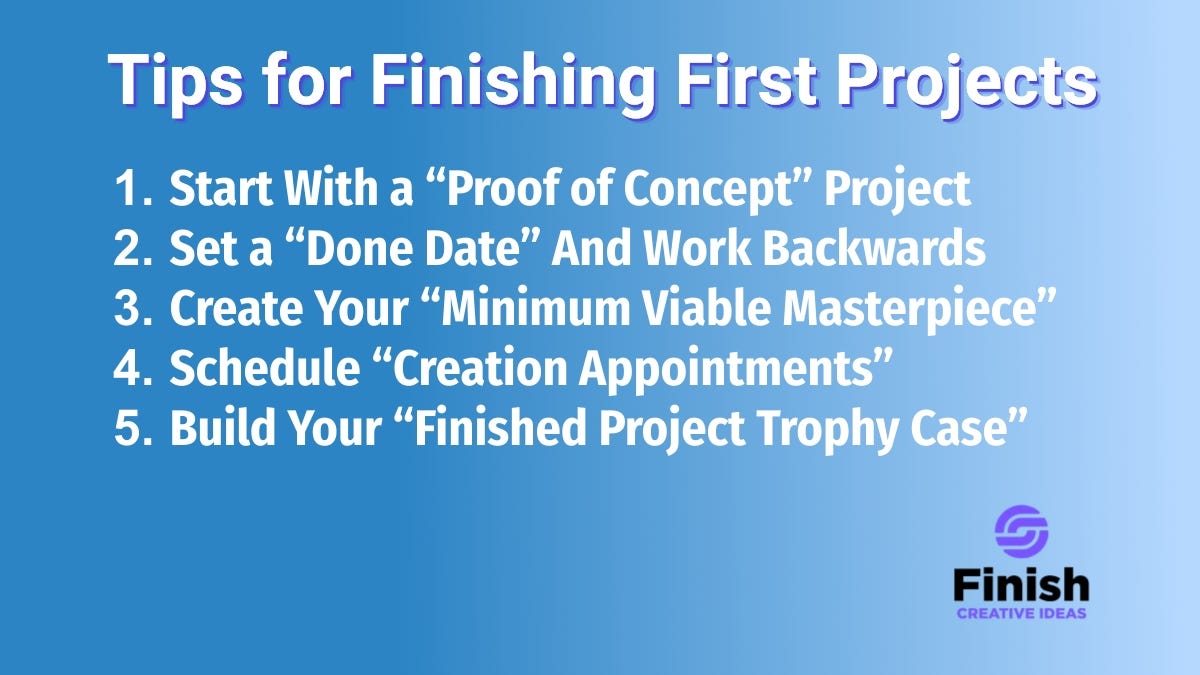
Tip #1. Start With a “Proof of Concept” Project
Prove it to yourself first.
Your first project should be small enough to complete within a few weeks or a month, nothing too elusive or grand that defeats your spirit.
Here’s why this matters psychologically:
Your brain doesn’t believe you can finish big projects because it has no evidence.
Every abandoned project reinforces this negative neural pathway.
Small completed projects rewire this belief system by creating new evidence.
Completing a project reveals your actual creative process.
Think about all the dynamics that go into a project and what you’ll discover:
your real working pace
your energy patterns
where you actually get stuck
what “done” feels like in your body and soul
This self-knowledge is worth more than any course or book because it’s specific to you.
Secondary benefits relate to generating income, gaining testimonials, starting a portfolio and possibly opening doors.
Unfinished projects generate guilt and stagnation.
ACTION STEP: Write down your big project idea. Now ask: “What’s the smallest experiment I could complete in 14 days that would test the core idea?” Not a piece of the big thing, an entire small thing.
If you want to write a novel, make it a 1,200-word short story with a beginning, middle, and end.
If you want to launch a YouTube channel, make it one fully edited 5-minute video.
If you want to create an online course, make it a single 20-minute lesson on your most specific skill.
Write this down as “Project Zero: [Your Idea]” with a completion date of 14 days from today.
Tip #2. Set a “Done Date” And Work Backwards
Reverse engineer your creative work process.
Pick a completion deadline first, then figure out the steps backward. Make it fit into your schedule and work load.
The truth about creatives is that they use planning as sophisticated procrastination. Though planning feels productive, it’s a false sensation because you’re not putting real work into the work. You are not vulnerable.
Deadlines kill excuses, especially public accountable ones.
Your brain switches from research mode to “get it done” mode.
Why is this such a powerful trigger?
Others are watching your efforts and making a judgment.
Your personal pride is on the line.
Your reputation as a creator is being tested, both internally and externally.
Do you need more pressure?
Psychologists reveal that public deadlines and commitments force you into “identity foreclosure.” When you declare your intentions to complete a creative project, you are also claiming a new identity.
Then your brain translates that into working harder to avoid cognitive dissonance, the discomfort felt by failing to live up to your new identity.
Creatives are far too comfortable with ‘open loops’ that keep options in a comfort zone, where nothing gets finished.
Deadlines are ‘closed loops.’
They make you choose an endpoint: this version, these features, this approach.
Not perfect, but done.
One consequence of known deadlines is that they attract unexpected support.
When people know you’re working on something with a real finish line, they tend to offer help, resources, introductions, or become your first customers.
None of this happens when your project lives in limbo.
ACTION STEP: Open up your calendar and find a date at least 30 days away and mark a specific date. Now write a version of this post:
“By [Date], I will complete and share [Your Project] that targets [Audience] for [Purpose]. Please reply if you want to see it when it’s ready.”
Post this to at least one social platform or send it to three specific people. You’ve just made a public commitment that your brain will work hard to honor.
Tip #3. Create Your “Minimum Viable Masterpiece”
Imperfect action calls for imperfect solutions.
Finishing creative ideas is on a spectrum. It’s a wide range from weeks to years to a lifetime.
Value is also conceived on a continuum of “just enough” to “overdelivered.”
Most unfinished projects die not from lack of skill but from scope creep, the endless addition of “just one more thing” that delays uploading indefinitely.
The real goal with a “Minimum Viable Masterpiece (MVM)” is shipping version 1.0 and done.
There’s a psychological trap to avoid by adding features. It feels like progress.
As long as you’re “improving” your project, you’re safe from criticism. But this safety is an illusion that costs you everything: time, momentum, learning, and opportunity.
Of course, the “Minimum Viable Masterpiece” is borrowed from the tech world concept of an MVP = Minimum Viable Product. All of us have bought early versions of software programs with bugs and glitches.
Silicon Valley is not afraid to ship a “less than perfect” product. It lets consumers clean up its mistakes.
Your “masterpiece” is still solid work, it’s just intentionally simple, focused and elegant within certain constraints.
Think about reality of your first or second project.
Your first version is just a scouting expedition to gather intelligence from the real market. It’s got nothing to do with your legacy at this stage.
What kind of feedback can you expect from Version 1.0:
What do people actually respond to?
What questions do they ask?
What do they wish you’d included?
What parts did they ignore?
This feedback is gold because it tells you what Version 2.0 should likely be.
But you only get this intelligence from finished work in the world, never from planning. Remember that iteration (Version 1.0, 2.0, 3.0 etc.) is the normal way forward.
Another bonus of an MVM is making a modest income from your product. This changes your relationship with your creative work.
Getting paid is an ego boost.
Here is what one finished MVM can do for your creative process:
It’s the first step in building a portfolio of digital assets.
It initiates your reputation in the marketplace.
It opens the door for collaboration opportunities.
It breaks the cycle of self-doubt to be a finisher.
The entire aim of creating an MVM is to simplify the process and start connecting yourself to your purpose.
ACTION STEP: Open a project document. At the top, write: “Everything I think my project needs to be complete.” Then list every feature, element, chapter, lesson, piece, or component. Next, rite: “The minimum version that would genuinely help someone.” Force yourself to identify only 3-5 core elements. Everything else gets labeled “Version 2.0 or Later.”
This is your actual project. Save this document and commit to building only what’s on the “minimum version” list.
Tip #4. Schedule “Creation Appointments”
Your personal work schedule is precious.
Just like for your family, the kids, and your health, priorities need to be set in order to achieve your duties and goals.
“Creation Appointments” are specific blocks of time slots in your calendar dedicate to working on your project. Treat them as non-negotiable commitments.
Don’t wait for “inspiration” or “free time” because neither will arrive on their own.
Inspiration is overrated.
We’ve romanticized the idea that “real” artists work when the muse strikes, in spontaneous bursts of genius. This mythology kills more creative careers than lack of talent ever will.
Professional creatives go to work. Period.
Artists approach an empty canvas. Musicians play around on the keyboards. Writers put their ass in the chair. Photographers drive to a new spot.
These consistent cues activate your brain to enter creative energy and flow.
It’s a kind of pattern recognition that starts generating ideas based on scheduled appearances over random sessions. Creativity becomes predictable.
Scheduled creative sessions do three powerful things:
First, they accumulate. For instance, three focused 90-minute sessions per week = 234 hours per year of deep creative work. That’s enough to write 3-4 books, build an online course and launch multiple digital products. Most creatives never complete projects because they’re waiting for 8-hour blocks of “free time” that never materialize.
Second, they create momentum that carries between sessions. Your subconscious works on problems in the background. You notice relevant ideas throughout your day. You make connections in the shower. This only happens when your brain knows another session is coming soon.
Third, they make creativity part of your identity rather than a hobby. When you maintain appointments with your work, you’re telling yourself what matters. This identity shift changes how you show up to everything else.
ACTION STEP: Open your calendar and find three 60-90 minute blocks in the next week to work on your project. Title each block as “PROTECTED PROJECT WORK.”
Set phone reminders before each block. Then write down one specific task to achieve in each session. Do not make an open loop.
Within minutes, you’ve scheduled your first three assignments with completion tasks ready to tackle. No lollygagging, just finishing.
Tip #5. Build Your “Finished Project Trophy Case”
Start dusting off the shelves and digging into the faded cardboard boxes.
You are going to create tangible evidence of your ability to finish things. Every small completed project or task adds heaps to your confidence level.
Whether puny or proud, a visible list or creative portfolio becomes ammunition against self-doubt and procrastination. It stamps your passport to the land of the finished.
Your brain makes decisions based on pattern recognition.
If your pattern is “I start but don’t finish” your brain predicts this outcome for every new project. Thus, triggering your negative side before you even begin.
Do not let doubt become a self-fulfilling prophecy. Do not reinforce a bad pattern.
A trophy case of completed work interrupts this loop.
It’s not about ego or showing off, it’s about creating clear and present evidence for your brain to contradict the “I never finish” story. Your trophy case is a reminder of your talent and tenacity.
Most creatives underestimate how much work they’ve actually done because it’s scattered and feels “too small to count.” Gathering it in one place reveals patterns:
What types of projects do you actually finish?
When are you most productive?
What format works best for you?
This self-knowledge is invaluable.
This trophy case approach also creates compounding benefits across different areas:
Psychological: It rewrites your identity from “aspiring creative” to “creative who ships work.” This identity shift affects every decision. Someone who ships work makes different choices than someone who only dreams about it.
Practical: When opportunities arise (e.g. a potential client, collaboration, speaking gig, job application) you have a ready portfolio (trophy case) to share. Most creatives are frozen out because their work is scattered or unfinished.
Motivational: On difficult days, scrolling through your completed work reminds you of your talent and capability. You’ve done hard things before. You can do hard things again.
Strategic: Patterns in your completed work reveal your strengths and interests. Your trophy case alerts you to the data of completed and abandoned ideas. This tells you something important about your actual process versus your imagined process.
Financial: Completed work can generate income directly via sales or indirectly via attracting clients. A trophy case makes your body of work discoverable and shareable.
ACTION STEP: Create a document titled “My Creative Trophy Case - [Your Name].” Set a timer and list every creative project you’ve actually completed—even small ones. Include social media posts, blog articles, videos, designs, songs, code projects, photos, anything you brought to a finished state and shared or could share.
Don’t judge the quality, just capture the fact that you finished it. You might be surprised with how much you’ve actually done. This is current your trophy case. Add to it every time you complete something new.
Your First Move
You don’t need to implement everything at the same time.
These are just recipes to have in hand and to alter to fit your unique circumstances.
Don’t be overwhelmed by tactics and tips. Just find one strategy that’s most relevant to where you are currently stuck.
For instance:
If you’re drowning in a too-big project, then try “Proof of Concept” or the “Minimum Viable Masterpiece.”
If you keep planning but never start, then try “Done Date” or “Creation Appointments.”
If you’re doubting whether you can finish anything, start building a small “Trophy Case.”
Pick one and implement it this week.
Let that one strategy break your current pattern.
You can always add more later.
Until next week,
— Rick
Comments & Takeaways
As Finish Creative Ideas gets started on its digital journey, it would be helpful to receive some input from our readers:
Please leave comments on the current articles presented
Suggest ideas on what needs to be covered in the future
Let us know your personal takeaways and perspectives
And any post re-stacks on Substack or sharing on social media is very much appreciated.
Now go be creative.